Personalized Medical Care & Dedicated International Patient Concierge

Medical Guide
MINT vs Silhouette Soft vs Dual Line Thread Lifting
Compare MINT, Silhouette Soft, and Dual Line thread lifts in Korea: PDO vs PLLA materials, barbs, cones, longevity, candidacy, and their realistic risks.
Schedule a ConsultationMINT vs Silhouette Soft vs Dual Line Thread Lifting
Medically reviewed by Dr. Kun Woo Kang, Korean Board-Certified Dermatologist
Thread lifting is one of the most searched aesthetic treatments among US patients considering Korea, and three names come up repeatedly: MINT, Silhouette Soft, and Dual Line. They share a common idea — placing fine absorbable threads under the skin to lift sagging tissue and stimulate collagen — but they differ in material, barb or cone design, longevity, and regulatory status. This guide compares them so you can ask better questions during a consultation. Importantly, none of these is a surgical facelift, and this article is educational rather than a treatment recommendation.
What a Thread Lift Is — and Is Not
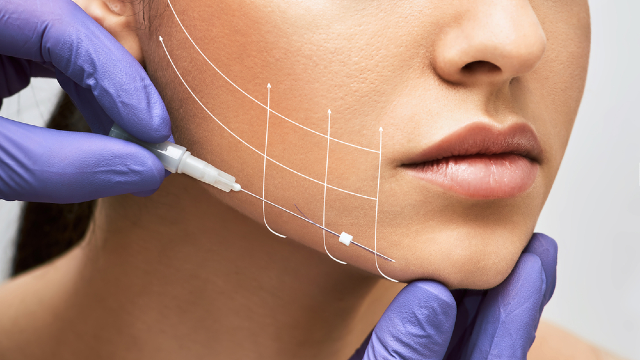
A thread lift is a minimally invasive procedure in which fine absorbable threads are inserted beneath the skin through small entry points to lift and reposition sagging tissue while stimulating the body's own collagen. The American Society of Plastic Surgeons (ASPS) describes thread lifts as offering results without the downtime or scarring of a surgical facelift, but also notes that the effect is temporary and suited to subtle adjustments rather than dramatic reshaping.
That distinction is the single most important point in this comparison: a thread lift is not a facelift. It does not remove excess skin or reposition deep structures the way surgery does. For patients with significant laxity, a thread lift will underdeliver, and a board-certified plastic surgeon should be consulted about surgical options. Threads are best thought of as a middle option — more lifting than energy devices provide, but far less than surgery. If you are unsure where your goals fall on that spectrum, our team can help clarify during a consultation.
Thread Material: PDO vs PLLA vs PLGA
The material a thread is made from influences how long it lasts and how it stimulates collagen.
- MINT uses PDO (polydioxanone), a synthetic absorbable material long used in surgical sutures. According to the manufacturer's US FDA clearance documentation, polydioxanone is nonantigenic and elicits only a slight tissue reaction during absorption. PDO threads typically dissolve over a period of months.
- Silhouette Soft uses PLLA (Poly-L-Lactic Acid). PLLA is a longer-lasting bioabsorbable material also known for stimulating collagen as it is absorbed, which is why PLLA threads are often discussed for gradual, longer-term collagen support.
- Dual Line is described by clinics as using biodegradable PDO threads, often in higher-density or specialized spring/core configurations aimed at both lifting and collagen stimulation.
A closely related material, PLGA (a poly-lactide/glycolide copolymer), appears in the US-FDA-cleared Silhouette InstaLift device (discussed below). Material alone does not determine which thread is right for you — placement, design, and your anatomy matter just as much.
Barbs vs Cones: How Threads Grip Tissue
Threads lift by anchoring into tissue, and the anchoring design differs between systems.
- Barbed threads (used by MINT and by Dual Line PDO systems) have tiny opposing barbs or hooks along the thread. The FDA clearance documentation for the MINT product family notes that its barbed PDO sutures approximate tissue without the need to tie surgical knots, using opposing barbs that embed in the tissue after precise placement.
- Cone-based threads are associated with the Silhouette approach, where bidirectional cones (rather than cut barbs) grip and suspend tissue. This is the mechanism used in the Silhouette family for cheek and mid-face suspension.
Barbs and cones both aim to hold lifted tissue in place while collagen forms around the thread, but they distribute tension differently. The choice is a clinical one based on the area treated, the degree of laxity, and the physician's technique.
Regulatory Status: US FDA vs Korean MFDS
Regulatory status is where these products differ most clearly, and precision matters for US patients.
- MINT (PDO) is US-FDA-cleared. FDA 510(k) documentation shows the MINT product family cleared for soft-tissue approximation where absorbable sutures are appropriate, with a later clearance covering "lifting" indications.
- Silhouette Soft is marketed internationally under MFDS (Korea) and CE (Europe) frameworks; it is not the version cleared in the United States. Its US-FDA-cleared counterpart is Silhouette InstaLift (a PLLA/PLGA cone suture), which FDA documentation describes as indicated for mid-face suspension to temporarily fixate the cheek subcutaneous tissues. In other words, the US-cleared product is InstaLift, while "Silhouette Soft" itself is an international/MFDS-CE product.
- Dual Line is a Korean-market thread cleared under MFDS; based on available public records it is not US-FDA-cleared. Its exact regulatory details for any given configuration should be confirmed directly with the clinic.
None of this means one thread is universally safer or more effective than another. FDA clearance reflects that a device is substantially equivalent to a legally marketed predicate for a defined use in the US market; it is not a ranking of quality. For international patients, however, understanding these distinctions helps set realistic expectations. You can learn more about the clinic's thread systems on our main site.
Longevity: How Long Results Last
Thread lift results are temporary because the threads are absorbed over time. ASPS notes that thread lift results can last up to around 18 months, though this varies widely between individuals and products.
- PDO threads (MINT, Dual Line) generally dissolve faster than PLLA, with lift maintenance often discussed in the range of roughly a year, after which the collagen-stimulating benefit may persist somewhat longer than the mechanical lift.
- PLLA threads (Silhouette Soft) are associated with longer-lasting collagen stimulation and are often discussed as lasting somewhat longer, though the mechanical lift still fades over time.
Because the effect is temporary, many patients consider repeat treatments to maintain results. Longevity depends on the product, the number of threads, the treated area, your tissue quality, age, and lifestyle. Results vary, and no thread lift is permanent.
Candidacy: Who Is a Good Fit
Thread lifting tends to suit patients with mild-to-moderate facial laxity who want subtle improvement without surgery and with limited downtime. It is often discussed for early jowls, mild cheek descent, and softening of the jawline. A physician determines candidacy after assessing your facial anatomy, skin thickness, and degree of laxity.
Patients with significant sagging, substantial excess skin, or heavy tissue are generally poor candidates for threads alone, because the lift may be modest and short-lived; a surgical consultation is more appropriate for them. ASPS emphasizes matching realistic expectations to the procedure. Active infection at the treatment site, certain medical conditions, bleeding disorders, and some medications may also make thread lifting inadvisable at a given time. This is why an in-person evaluation, not an online promise, is the right first step.
Risks and Realistic Expectations
Although minimally invasive, thread lifting is still a medical procedure with real risks. Recognized possibilities include:
- Dimpling or puckering of the skin at insertion points, which is often temporary but occasionally persistent.
- Thread extrusion or migration, where a thread becomes visible or palpable or works its way toward the surface.
- Asymmetry, if the two sides settle differently.
- Infection, bruising, swelling, and discomfort at entry points.
- Palpability, where threads can be felt under the skin, and rare snapping or breakage.
ASPS notes most patients return to normal activity within one to three days, with swelling, redness, and tenderness at entry points for a few days. Serious complications are uncommon in experienced hands but are more likely when technique or candidate selection is poor. Choosing a qualified physician and having realistic expectations are the best safeguards. Threads do not treat surface concerns such as pigmentation or fine surface lines, and they do not replicate surgical results.
Preparing for a Thread Lift and Aftercare
Preparation for a thread lift begins with a one-on-one consultation in which the physician maps your facial anatomy, evaluates laxity and skin thickness, and explains which thread system and how many threads may suit your goals. You may be advised to avoid blood-thinning medications or supplements and alcohol for a period beforehand, at the physician's discretion, to reduce bruising. Honest expectations are essential: threads offer a subtle lift, not surgical rejuvenation.
Aftercare commonly involves avoiding wide mouth movements, vigorous facial massage, dental work, and strenuous exercise for a short period so the threads can settle, along with sleeping face-up and being gentle with the treated area. Some swelling, tenderness, or mild bruising at entry points is normal for a few days. Any specific pre-procedure and recovery instructions should be confirmed directly with the clinic, since they are individualized. International patients should also plan their trip length to allow for settling and any recommended follow-up before flying home, and report any signs of infection or unusual pain promptly.
The Bottom Line
- MINT (PDO) is US-FDA-cleared for soft-tissue approximation and lifting; Silhouette Soft is an international/MFDS-CE product whose US-FDA-cleared counterpart is Silhouette InstaLift (PLLA/PLGA); Dual Line is a Korean-market, MFDS thread that is not US-FDA-cleared.
- Material differs — PDO (MINT, Dual Line) versus PLLA (Silhouette Soft) — as does anchoring design, with barbed threads (MINT, Dual Line) and cone-based suspension (Silhouette).
- Results are temporary, typically discussed in the range of roughly a year up to around 18 months depending on product and person; results vary and no thread lift is permanent.
- Thread lifting is minimally invasive and is not a surgical facelift; patients with significant laxity should consult a plastic surgeon.
- Every thread lift carries risks such as dimpling, extrusion, asymmetry, and infection; candidacy and product choice are individualized and there is no single "best" thread.
Frequently Asked Questions
Which thread lift is best, MINT, Silhouette Soft, or Dual Line?
There is no single best thread. Each uses different materials and designs, and the more suitable option depends on your anatomy, degree of laxity, treatment area, and goals. A physician recommends a specific system after an in-person assessment rather than one product being superior for everyone.
Is a thread lift the same as a facelift?
No. A thread lift is minimally invasive and repositions tissue with absorbable threads, while a surgical facelift removes excess skin and repositions deeper structures for a longer-lasting, more dramatic result. If you have significant sagging, a board-certified plastic surgeon should assess whether surgery is more appropriate.
Are these threads FDA-approved?
MINT PDO threads are US-FDA-cleared, and Silhouette's US-FDA-cleared product is InstaLift, while "Silhouette Soft" itself is an international/MFDS-CE product. Dual Line is cleared under Korea's MFDS but is not US-FDA-cleared. Note that devices are FDA "cleared," not "approved," and clearance is not a quality ranking.
How long do thread lift results last?
Results are temporary. Depending on the product and the individual, the lift is often discussed as lasting roughly a year up to around 18 months, with collagen benefits sometimes persisting a bit longer than the mechanical lift. Longevity varies with thread type, number of threads, and your tissue, so many patients consider maintenance treatments.
What are the main risks of thread lifting?
Recognized risks include dimpling or puckering, thread extrusion or migration, asymmetry, bruising, swelling, infection, and the threads being felt under the skin. Serious complications are uncommon with an experienced physician, but no procedure is risk-free. Discuss your individual risks during consultation.
How much downtime does a thread lift require?
Downtime is usually limited compared with surgery. The American Society of Plastic Surgeons notes most patients return to normal activity within one to three days, with some swelling, redness, and tenderness at entry points for a few days. Individual recovery varies.
Who is not a good candidate for a thread lift?
Patients with significant laxity or heavy tissue often see only modest, short-lived results and are usually better served by a surgical consultation. Active infection, bleeding disorders, certain medications, and some medical conditions may also make threads inadvisable. A physician confirms candidacy in person.
This article is for general educational purposes about aesthetic and cosmetic-dermatology treatments and does not constitute medical advice, a diagnosis, or a treatment recommendation. Thread systems, candidacy, and outcomes vary by individual, and all procedures carry risks. Please consult a qualified physician for an in-person assessment before making any decision. It is not a self-diagnosis tool.
More Articles
Continue reading our clinical guides.

Hidden Fees to Ask About Before Booking Care Abroad
Aesthetic treatment abroad has fees beyond the procedure. Know the questions to ask about consultations, aftercare, follow-up, numbing, and travel costs.
Learn More

Sofwave vs Ultherapy Prime: Ultrasound Lifting Compared
Compare Sofwave and Ultherapy Prime, two FDA-cleared ultrasound lifting devices, by mechanism, depth, comfort, downtime, and candidacy for Seoul patients.
Learn More

Dr. Kang Hyun Uk: Filler & Laser at Newstar Clinic
Meet Dr. Kang Hyun Uk, a Medical Doctor at Newstar Clinic in Gangnam, Seoul, focused on minimally invasive filler and laser care with a balanced approach.
Learn More